
Let's address the elephant in the room. An organisation evaluates an AI platform, likes what it sees, and then spots the word DeepSeek in the model catalogue. Alarm bells ring. Board members ask questions. Security teams draft memos about data flowing to China.
We understand the concern — and we want to dismantle it completely, because the reality of how we serve open-source models is the exact opposite of what the fear assumes.
Weights only. Nothing else.
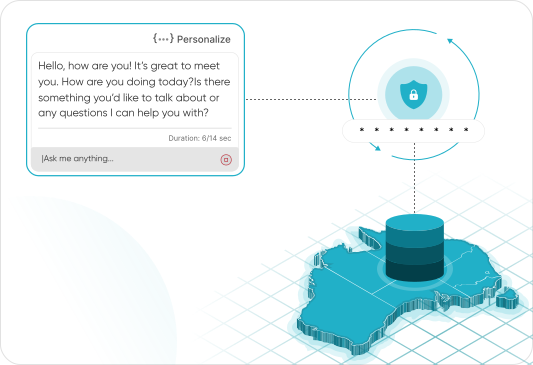
When an open-source model such as DeepSeek or Qwen appears in our catalogue, we are serving only the published weights of that model — the mathematical parameters released openly by their creators. There is no third-party API behind it, no relay, no proxy, and no connection of any kind to the original provider. In the case of DeepSeek, that means nothing we run ever points to China. Not at inference time, not at training time, not ever.
The weights are imported into our own infrastructure, fine-tuned as required so each model performs well on our stack, and then served from data centres we manage ourselves. From that moment on, the model is entirely ours to operate — more like software we have compiled and hardened than a service we subscribe to.
Air-gapped, with zero data retention
Every open-source model we serve runs air-gapped with absolutely zero data retention, both at rest and in transit. Your prompts, your documents and your agent conversations never leave the region you choose, are never stored by us, and are never visible to anyone but you. This is the standard we hold every model in our catalogue to — open weights or otherwise.
Served in your region, chosen by you
Inference is served from three sets of data centres we manage specifically for our customers, in the following availability zones:
- Australia — Sydney/Melbourne
- Europe — Frankfurt/London
- United States — East/West Virginia
Which model you use and where it is served is transparently chosen by you. And because compliance policies differ, workspace admins can enable or disable individual models — Qwen, DeepSeek, or any other — at the workspace level. If your internal policy says no DeepSeek, one toggle makes it disappear for your entire organisation.
Our position is simple: we give organisations freedom of choice — and the controls to enforce it.
The same pipeline behind Sorcerer and Mystica
This is not a bolt-on capability. The very same weights-and-fine-tuning pipeline is what we use internally to create our own model families — Sorcerer and Mystica — which are novel models served across all our regions. We take pre-trained open-source weights, adjust them to our stack, and serve the results sovereignly. Recently we have been exploring the same approach with Mistral and Gemma models together with customers in Australia and the EU.
In other words, the way we serve DeepSeek is the same way we build our own models. It is one disciplined, secure pipeline — and your organisation benefits from it either way.
One platform, four layers
For context, the model serving described above is the first of four layers that make up ToothFairyAI:
- Model predictions and inference — the model catalogue and inference regions described above, served from Australia, Europe and the US
- Programmatic integration — SDK, CLI, API and MCP, so teams can build on the platform from any stack
- User layer — the web, mobile and desktop apps where teams work with agents day to day
- TF Code — a coding-agent environment in the same space as Claude Code, with native agents that bring the whole platform together
Several customers use just the inference layer with our SDK and MCP to build custom solutions on both backend and front-end — the platform is designed to be adopted layer by layer, not all at once. And the entire solution can run fully offline and air-gapped, locally, with virtually any model that supports vLLM, Llama.cpp or MLX — as a server, CLI, TUI or web app.
The takeaway
Seeing DeepSeek or Qwen in a catalogue should not be a red flag — it should be a sign that a platform is giving you access to the best open intelligence available, on your terms. The questions that matter are: who runs the infrastructure, where does inference happen, where does your data go, and can you switch models off when policy demands it?
On ToothFairyAI, the answers are: we do, in the region you choose, nowhere, and yes. That is what sovereign AI actually means.